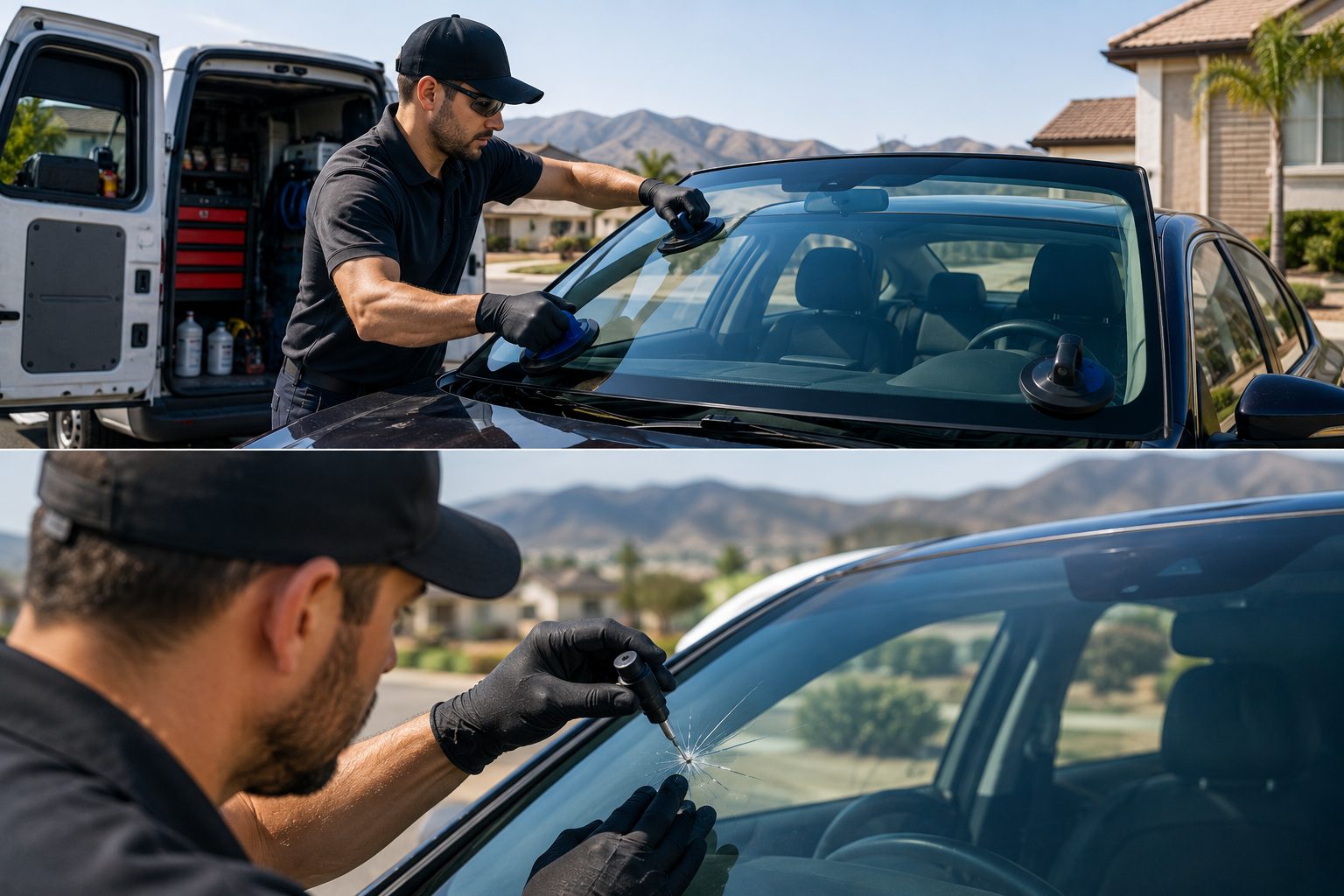
When Auto Glass Replacement Is the Only Safe Option for Your Vehicle
This article explains when windshield damage progresses beyond repair, how safety systems depend on intact glass, and what conditions require full replacement instead of corrective sealing.
When Damage Exceeds the Limits of Auto Glass Replacement
Replacement becomes necessary when cracks or chips compromise the windshield’s structural laminate, extend across the viewing field, or reach the glass edges. Repair cannot restore strength once damage interacts with the bonded layers.
Common triggers for mandatory replacement include:
- Any crack that reaches the edge of the windshield
- Laminate separation or “milky” discoloration
- Cracks that obstruct the driver’s direct visual zone
- Multiple chips indicate accumulated stress
- Damage that compromises adhesive bonding points
When a windshield cannot sustain impact resistance or maintain full laminate integrity, the glazing should be replaced instead of restored. A structurally compromised windshield does not behave predictably under force.
When a Crack Interferes With Driver Visibility
A crack that obstructs a central field of view cannot be adequately repaired because any distortion alters distance judgment, depth perception, and clarity. Optical scatter increases when cracks refract light.
Visibility concerns include:
- Glare reflection during night driving
- Blur and image distortion in bright sunlight
- Difficulty tracking lane markings
- Distraction created by line breaks in the field of view
When visual reliability declines, safe operation cannot be maintained at routine driving speeds. Clear windshield surfaces support consistent visual performance.
When Safety Systems Depend on Windshield Structure
Modern vehicles rely on the windshield as a load-bearing and sensor-supporting component. Laminate construction contributes to cabin stability, airbag deployment, and occupant containment.
Safety functions supported by the windshield include:
- Preventing ejection during forward impact
- Providing surface support for airbag deployment
- Contributing to roof-crush resistance in rollovers
- Maintaining bonded seals between structural pillars
If integrity is lost, collision performance may not follow its engineered design. Replacement restores the stability required for a predictable safety response.
When the Size and Length of a Crack Surpass Repair Limits
Chip repair is engineered for localized stabilization. Resin cannot correct cracks that exceed depth or length tolerances. Once a crack propagates outward, the structural cavity expands beyond the reach of bonding materials.
Material-related limits include:
- Resin cannot reinforce multiple fracture lines
- Long cracks introduce unpredictable stress pathways
- Widened impact points prevent full penetration
- Load distribution changes across weakened zones
Once damage surpasses physical thresholds, corrective sealing does not restore protective strength. Replacement returns the surface to full uniform resistance.
When Road Vibration Accelerates Crack Movement
Glass endures continuous vibration while a vehicle is in motion. If a crack exists, these forces encourage further propagation. The longer a damaged windshield remains in service, the more unpredictable the fracture pattern becomes.
Vibration effects include:
- Stress transmission from uneven surfaces
- Impact from potholes or gravel
- Structural flex from braking
- Load change from highway airflow
Propagation caused by vibration cannot be stabilized once fractures spread. Replacement prevents continued structural decline.
When Laminate Separation Becomes Visible
A windshield contains two glass layers bonded to an inner laminate sheet. When impact separates these layers, optical distortion and structural weakness increase. Repair cannot restore laminate bonding.
Indicators of separation include:
- Cloudy or milky patches inside the glass
- Moisture tracing between layers
- Diffused distortions near the crack area
- Visible delamination along edges
Once laminate separation forms, replacement returns the structural barrier required for occupant protection.
When the Vehicle Contains ADAS or Sensor-Mounted Hardware
Advanced Driver Assistance Systems rely on optical clarity. A crack can misalign sensors, reduce imaging accuracy, or distort the reflected field. Repair cannot correct alignment if the glass surface is compromised.
ADAS systems commonly affected include:
- Lane-departure warning cameras
- Collision-avoidance sensors
- Adaptive cruise control units
- Automatic braking support
If sensors depend on windshield placement, replacement may also require calibration. This ensures the system measures distance and alignment correctly.
When a Vehicle Must Comply With Inspection Requirements
Many jurisdictions restrict cracked windshields in the driver’s primary field of view. Passing inspections typically requires clean sightlines and structural uniformity. A vehicle may fail evaluation if cracks exceed the regulated dimensions.
Inspection considerations include:
- Maximum permitted crack length
- No breaks within driver sight zones
- No obstruction of wiper contact areas
- No signs of structural lift or separation
Compliance protects road safety. Replacement becomes necessary when damage meets the disqualification criteria.
When Damage Prevents a Secure Environmental Seal
Windshields block external elements from entering the cabin. When cracks disrupt the seal, water intrusion may reach interior components. Long-term exposure increases corrosion potential. Repair cannot correct sealing defects once the bonding edge is compromised.
Seal disruption may cause:
- Moisture accumulation in the dashboard
- Mold formation under trim components
- Electrical exposure near sensors
- Noise from air intrusion at highway speed
Replacement restores environmental isolation, surface tension, and bonded uniformity.
When Damage Creates Uneven Glass Load Distribution
A windshield balances external and internal cabin forces. When cracking interrupts load paths, pressure distributes unevenly across the surface. Repair does not reconstruct lost rigidity.
Structural imbalance creates:
- Greater risk of sudden expansion
- Reduced accident-impact resistance
- Difficulty containing fractured glass
- Unpredictable failure points
Uniform construction is necessary to support vehicle strength. Replacement reinstates consistent pressure absorption.
When Repair Cannot Guarantee Clarity or Stability
Repair improves appearance only when the fracture area remains confined and receptive. It is not a restorative process for large-scale distortion. Replacement becomes the only option when sustained clarity and rigidity are required for safe operation.
Repair limitations include:
- Variable optical results
- Limited reinforcement depth
- Inconsistent bonding success
- Persistent visibility distortion
Replacement delivers consistent uniformity because a new windshield meets design expectations.
When Auto Glass Repair Is No Longer Appropriate
Repair is only feasible when the damaged area remains small, clean, and structurally contained. Once cracks expand, contaminate, or compromise adhesion, the method cannot meet safety standards. At that stage, replacement provides the required performance for visibility and protective strength.
Replacement becomes necessary when:
- Repair cannot penetrate deep cavities
- Cracks cross-regulate visibility zones
- Multiple fractures signal structural decline
- Laminate performance is degraded
- Adhesive support cannot be guaranteed
Once these indicators are present, full installation is a corrective requirement rather than a preference. A qualified provider, such as Lowest Price Auto Glass & Tint, can install a windshield according to bonding and sealing expectations.
Frequently Asked Questions
Can small cracks eventually require full replacement?
Yes. Once a crack spreads or reaches an edge, repair is no longer viable.
Do all windshield chips need to be repaired immediately?
Chips should be evaluated quickly because temperature and vibration can cause damage.
Can a cracked windshield still support airbag deployment?
A weakened windshield may not provide proper support during airbag expansion.
Does moisture prevent effective resin repair?
Yes. Water and debris reduce resin bonding strength.
Is replacement required when a crack blocks driver's vision?
Yes. Any visibility obstruction typically disqualifies repair.
Can a windshield pass inspection with cracks?
Cracks in regulated sight zones or beyond maximum limits may cause inspection failure.
Do ADAS sensors require recalibration after replacement?
If sensors rely on windshield mounting, recalibration may be required.
Is replacement always more costly than repair?
Yes. Replacement requires complete installation and adhesive curing.
Final Thought
Replacement is necessary when structural integrity, clarity, or bonding reliability cannot be maintained. Once repair thresholds are exceeded, corrective sealing does not restore safety performance. Assessing windshield damage early helps determine whether repair or full replacement is appropriate.